
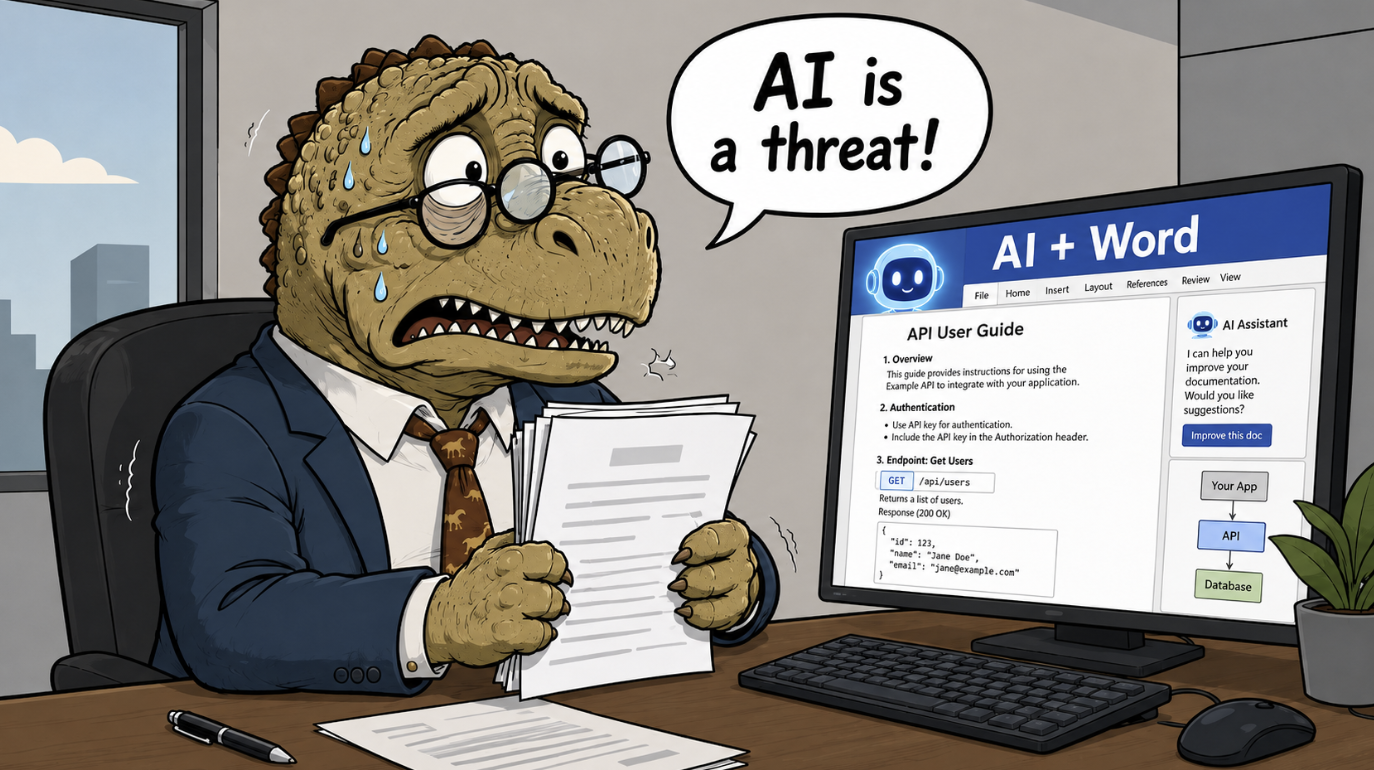
Let’s get the objection out of the way first.
Yes, AI helped produce this article.
I’ve been a technical writer on and off for nearly 20 years.
Government, healthcare, finance, aviation, telecommunications.
I use these tools daily.
I use them deliberately, without guilt.
The argument against doing so doesn’t hold up well, so it’s worth taking apart.
📊 Two numbers worth knowing
Most of the commentary on this topic is feeling dressed up as analysis.
Two pieces of research cut through it.
Microsoft Research analysed roughly 200,000 Copilot conversations across 785 occupations, ranking writers near the top for AI applicability. Their own researchers stressed that a high applicability score doesn’t mean the job will be replaced.
That distinction is the whole argument.
Our profession is heavily exposed.
Exposure isn’t displacement.
The second number tests that.
In the sectors most exposed to AI, employment has slipped only about 1% since late 2022, even as average wages in those sectors rose faster than the national average, according to the Federal Reserve Bank of Dallas.
Flat employment.
Rising pay.
That’s not what a profession being wiped out looks like.
🧠 The fear isn’t really about jobs
Here’s what I think is actually going on.
Most resistance I’ve seen isn’t economic.
It’s about identity.
If being the person who produces polished prose is central to who you are, a tool producing serviceable prose in 30 seconds feels like a personal attack.
That’s not irrational.
It’s just a different problem to the one people think they’re arguing about.
Nobody says “this threatens my sense of myself”.
They say “the output is soulless”.
Both might be true.
Only one of them is the reason for the reaction.
🎨 Every profession works through this
The pattern repeats everywhere.
Photographers said the same things about digital.
Illustrators said them about design software.
Developers are saying them now about coding assistants.
The sequence tends to run resistance, then reluctant experimentation, then quiet adoption, then wondering what the fuss was.
We’re somewhere in the middle of that.
People still in the first phase aren’t wrong to feel what they feel.
They’ll just arrive at the later phases with less accumulated skill than everyone who started earlier.
⚡ What it actually does for me
Enough theory.
Here’s the practical case.
The tedious parts of this job used to eat most of the week.
- Turning a 50 minute SME recording into structured notes
- First drafts of procedures, release notes, quick reference guides
- Restructuring an existing document into a different template
- Checking terminology stays consistent across 40 pages
- Producing 5 draft examples so 1 usable one emerges
- Finding gaps across a documentation set nobody’s read end to end
- Rewriting dense engineering text for a contact centre audience
- Generating an outline in seconds rather than an afternoon
All of that used to be hours.
Now my day is mostly verification, judgement, final polish.
Which, if we’re honest, is where the value always sat.
🔍 The part that still needs me
None of these tools know that a field name has been guessed rather than confirmed.
They can’t tell that “approved by management” means something different in each department.
They don’t notice a step depending entirely on 1 person who’s been there 14 years.
They can’t recognise that a 5 page procedure is evidence of an interface problem, not a writing problem.
Text that reads confidently is harder to check than text that reads awkwardly, since nothing signals a problem.
That’s exactly why experienced writers matter more now, not less.
We’re the only quality control in the process.
✅ Use it or don’t, the work moves anyway
I’m not trying to convince anyone.
If someone wants to spend their remaining years defending the craft of typing up what an SME told them, that’s their call.
I’d just point out that the value was never in the typing.
It was in knowing what the reader needs, getting the truth out of busy people, then making something complicated feel simple.
Those skills held up completely.
The tooling changed.
Refusing to touch it doesn’t preserve the profession.
It just means doing the same work slower than whoever you’re competing with for the contract.
I’ve never enjoyed this job more than I do now.
Less formatting, more thinking.
That seems like a straightforwardly good trade.
About the author
Aiver Ilaya is an IT consultant based in Melbourne. For 19 years he’s worked on enterprise digital transformation programs. His experience spans ITSM, HRIS, ERP, CRM, POS, KMS and EDRMS platforms, plus workflow automation. He has worked across government, healthcare, science and medical research, finance, education, telecommunications, infrastructure, aviation, construction and property, technology, retail, logistics, pharmacy, insurance and professional services.
His work covers business analysis, process optimisation, technical writing, knowledge management and UI / UX design. He has worked on multi-million dollar programs running years at a time, for national organisations and global firms, reaching millions of end users.
He has run his own consultancy for 12 years and works with a small number of clients at a time. Available for remote and hybrid contracts.
alisodigital.com