

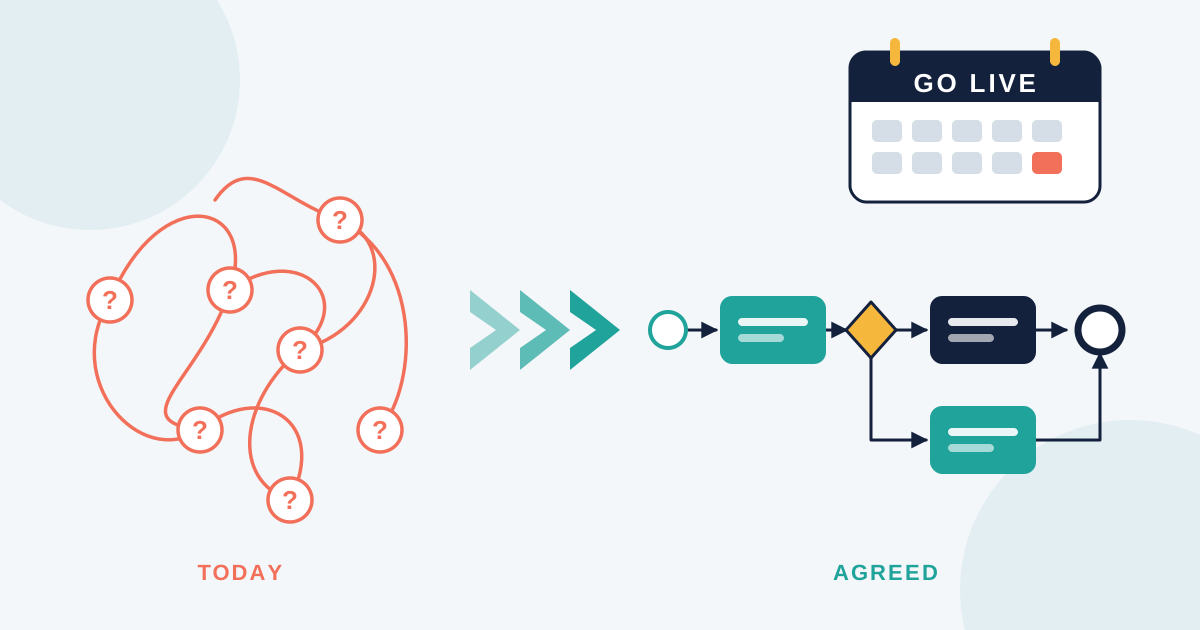
The vendor has a go live date.
The steering group has a budget.
Then someone asks a simple question.
“How does this process actually work today?”
Four teams give four different answers.
Nobody’s wrong.
Nobody has ever written the work down end to end, so the vendor is designing against a 2019 document.
That’s a stressful spot with 8 weeks to go.
It’s also more common than most programs admit, plus it’s fixable.
😬 Why this happens on almost every program
Work changes faster than documents do.
Each team sees its own segment clearly, then guesses at what happens either side.
Different sites build different habits, because head office never checked.
A manager describes the process they designed, while their team runs another one.
None of this is carelessness.
It’s what happens when nobody owns the whole picture.
The risk is that the system gets built around the version that was easiest to describe, not the one people actually use.
🚩 Signs you’re in this spot
- Two teams describe the same handoff differently
- The vendor’s design sessions keep producing new questions
- Nobody can say who approves the exceptions
- Training is booked, but no procedures exist yet
- A compliance step lives in a spreadsheet on someone’s desktop
If 2 or more sound familiar, the gap is real.
Better to name it now than at user acceptance testing.
💸 What skipping it costs
Skipping current state work looks like it saves time.
It only defers the discovery.
The exceptions still exist.
They just turn up at testing, or after go live, when changing course is expensive.
The service desk fields 3 or 4 times the usual contacts in the first quarter.
Staff keep using the old spreadsheet.
Data quality drops.
Six months later, a contractor gets hired to rebuild the documentation from scratch at twice the cost.
🗓️ An 8 week plan that works
Here’s the sequence I use when time is short.
Week 1. Get it in writing.
Ask each stakeholder to describe their part in plain words, as if explaining it to a new starter.
It takes 10 minutes at their desk.
No template, no notation, no audience.
People are more honest in writing than in a room.
Chase once, then book 15 minutes with anyone who doesn’t reply.
Weeks 2 to 3. Build one consolidated current state.
Pull the accounts into a single BPMN 2.0 map.
Mark every point where people contradict each other.
Add rough volumes, so you know which paths matter.
AI tools speed up the reconciling, as long as every output gets verified.
Week 4. Reconcile in short sessions.
Run 60 minute sessions on the marked disagreements only.
Ask what would explain the difference, not who’s right.
Hand each decision to whoever owns the process.
Weeks 5 to 6. Design the future state, then write for day 1.
Map the future state with the people who’ll live in it.
Pick the 20 tasks people genuinely need in week 1.
Write those work instructions first, then schedule the rest.
Weeks 7 to 8. Verify, then prepare for hypercare.
Follow every procedure in the live system, exactly as written.
Link each task on the map to its instruction using a stable ID.
Name an owner for each process area before the project team rolls off.
Only have 4 weeks?
Compress weeks 1 to 3 into 1 week, then cut the day 1 set to 10 tasks.
📋 What to hand the steering group
Lead with findings, not diagrams.
- The risks uncovered, such as manual controls nobody had documented
- Exception paths, with volumes attached
- Single points of failure, named
- The decisions that still need an owner
- The day 1 documentation set, ready to publish
The maps go in the appendix.
Sponsors respond to risk, not notation.
🤝 Why people matter more than the maps
The notation is the easy part.
Getting 20 busy people to tell you the truth is the hard part.
Turn up with a rough draft, never a blank wall.
Keep groups to 6 or 8.
Follow up privately with anyone who stayed quiet, because they’re often holding the exceptions.
Say the awkward thing early.
Something like “you’ve each described this slightly differently, which is normal”.
People relax once it’s said out loud.
✅ If you’re in this position now
Eight weeks is tight, not impossible.
The programs that struggle are the ones that wait until week 4 to admit there’s a gap.
I’ve been brought in at exactly this point many times, across government, healthcare, telecommunications, plus finance.
It’s a calm, practical exercise when someone owns it.
If that’s where you are, book a free 30 minute call.
We’ll talk through your systems, your timeline, then you’ll leave with a plan in plain language.
About the author
Aiver Ilaya is an IT consultant based in Melbourne. For 19 years he’s worked on enterprise digital transformation programs. His experience spans ITSM, HRIS, ERP, CRM, POS, KMS and EDRMS platforms, plus workflow automation. He has worked across government, healthcare, science and medical research, finance, education, telecommunications, infrastructure, aviation, construction and property, technology, retail, logistics, pharmacy, insurance and professional services.
His work covers business analysis, process optimisation, technical writing, knowledge management and UI / UX design. He has worked on multi-million dollar programs running years at a time, for national organisations and global firms, reaching millions of end users.
He has run his own consultancy for 12 years and works with a small number of clients at a time. Available for remote and hybrid contracts.
alisodigital.com