
Every workplace has that one person who knows how everything actually works.
Call her Jane.
Jane knows why the invoice template has that weird extra field.
She knows which supplier to ring when the usual one goes quiet.
She knows the three steps nobody ever wrote down that keep the whole thing running.
Then Jane takes long service leave, and the wheels fall off.
Sound familiar?
Here’s the bit most businesses get wrong.
They think the fix is a knowledge base.
Or they think the fix is a process map.
The fix is both, working together, and that’s a much bigger deal than it sounds.
What each one actually does
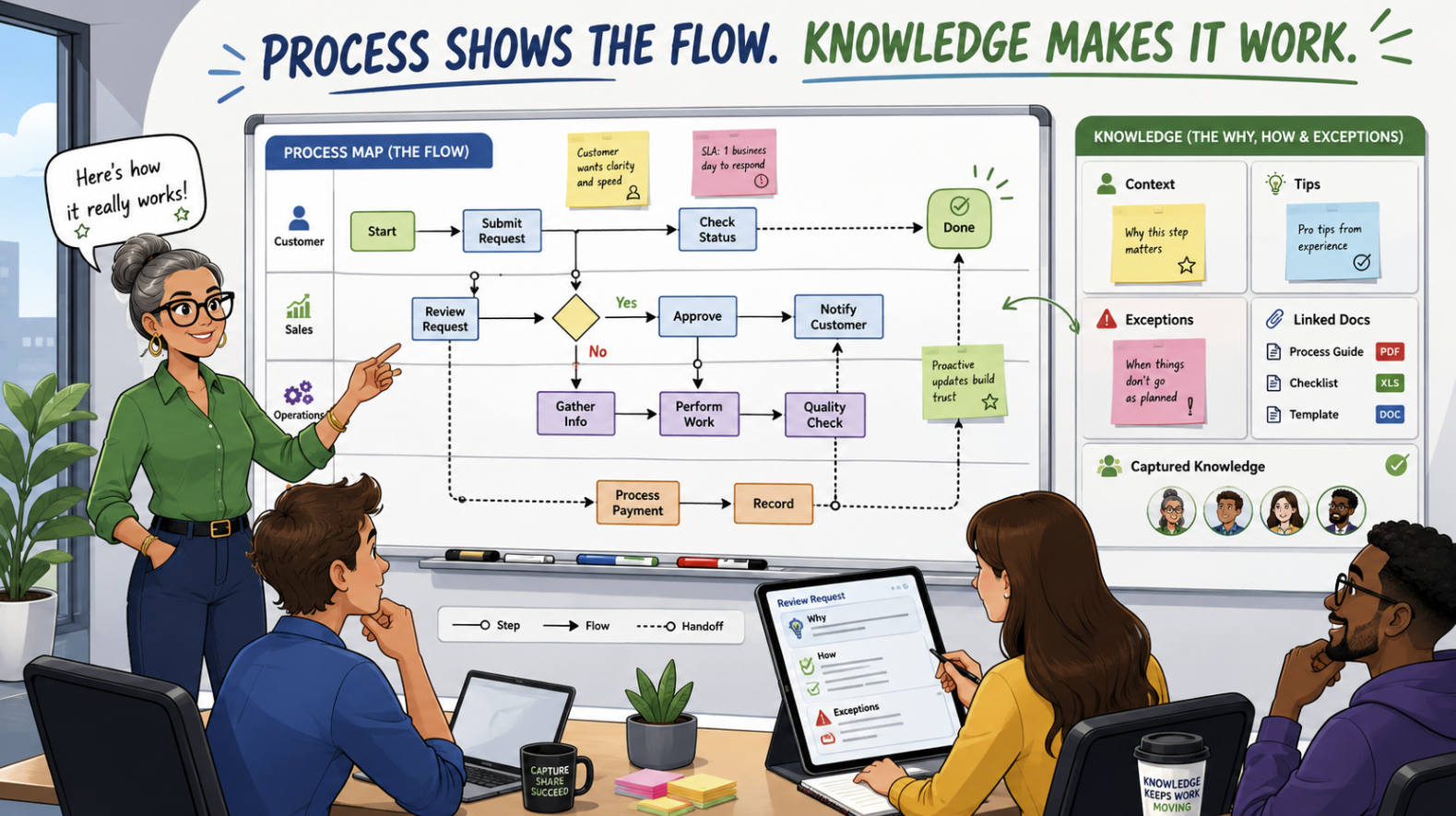
Process mapping shows you the sequence.
It’s the what happens next, who touches it, and where the handovers sit.
A good map lays the steps out in order so anyone can follow the flow without guessing.
Knowledge management is the why and the how.
It’s the context, the decisions, the exceptions, and the hard-won judgement that lives in people’s heads.
One without the other leaves you half finished.
A process map with no knowledge behind it is a set of boxes and arrows nobody trusts.
A knowledge base with no process behind it is a pile of documents nobody can find their way through.
Why the pairing works so well
Think about how your brain handles new information.
We learn better when we’ve got a structure to hang things on.
Cognitive load research has been saying this for decades.
When people are given a mental framework first, they hold onto the detail far better than when they’re handed the detail cold.
A process map is that framework.
It gives someone the shape of the work before they get buried in specifics.
Then the knowledge sits inside that shape, right where it’s needed.
Step four asks you to approve the purchase order.
Click through, and there’s the approval threshold, the escalation path, and the note about what happened last time someone skipped it.
That’s the pairing doing its job.
The bit most people skip
Mapping a process usually turns up things nobody expected.
You’ll find steps that only exist because of a system retired four years ago.
You’ll find two teams doing the same task in different ways, both convinced theirs is the official one.
You’ll find approvals that add a week and no value.
This is the good stuff.
Mapping isn’t just documentation, it’s an audit in disguise.
And the conversations you have while mapping are where the real knowledge comes out.
People will tell you things in a mapping workshop that they’d never think to write down on their own.
So record it while it’s still in the room.
Don’t just capture the boxes.
How to actually start
Pick one process that hurts.
Not the biggest one, the most annoying one.
Onboarding a new client, closing off a job, handling a refund request.
Something with real pain and a clear start and finish.
Map it with the people who do the work, not the people who think they know how it’s done.
Those are usually different groups.
Keep it simple, because a swim lane diagram beats a fifty page manual every time.
Then, at each step, ask one question.
What would a new person need to know here that isn’t obvious from the box?
Whatever the answer is, that’s your knowledge asset.
Link it, attach it, embed it.
Keep the map as the front door and the knowledge sitting right behind it.
Keeping it alive
Here’s where most efforts fall over.
The map gets made, everyone claps, and eighteen months later it’s wrong.
Give every process an owner.
Give it a review date.
Make updating it part of the job rather than a special project that never quite happens.
A slightly messy map that’s current beats a beautiful one that’s out of date.
And when something goes wrong, ask whether the map failed or the knowledge failed.
Usually one of them did.
Fix the gap while you remember it, not at the next review.
What you actually get out of it
New starters get productive in weeks instead of months.
Handovers stop being terrifying.
Audits stop being a scramble.
Your best people stop spending half their week answering the same five questions.
And you stop being one resignation away from a very bad quarter.
You also get a business that can be sold, audited, or handed over without a three month panic.
None of this is glamorous work.
But the businesses that do it well are noticeably calmer than the ones that don’t.
They’re not smarter.
They’ve just written down what everyone else keeps carrying around in their heads.
Jane can take her leave.
The work keeps moving.
That’s the whole point.