
You’ve got a system going in.
The budget’s approved.
Now you need someone to help land it.
You search for a consultant, then book a few calls.
Every one of them says they’re experienced, collaborative, plus great with stakeholders.
How do you tell them apart?
The usual questions don’t help much.
Years of experience, platforms they’ve used, clients they’ve worked for.
Those are fine to ask.
They just don’t predict whether your program will go well.
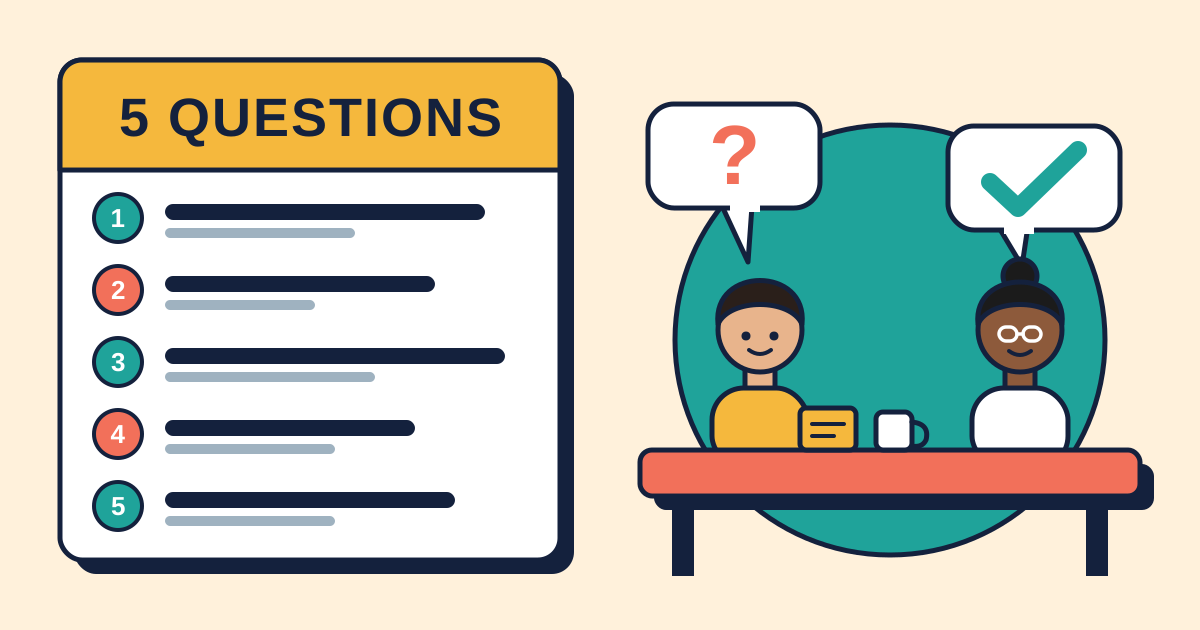
These 5 questions do.
🗣️ 1. How do you get the truth out of busy people?
This is the most important question.
The information a program needs sits in people’s heads.
It’s not in the old procedures.
A good consultant has a clear method for getting it.
Listen for answers like these.
- They turn up with a rough draft, never a blank page
- They ask 3 or 4 specific questions, not “walk me through the process”
- They book 15 or 20 minutes, not an hour
- They follow up privately with anyone who stayed quiet in a workshop
A weak answer talks only about templates.
Templates are easy.
Trust is the hard part.
⚔️ 2. What do you do when two teams disagree?
They will.
Two teams describing the same process differently is the most common conflict on any program.
Both are usually right.
They’ve just been doing it their own way for years.
A good answer sounds calm.
They write both versions down, in each team’s own words.
They show what each version costs in time, rework or risk.
Then they hand the decision to whoever owns the process.
A red flag is “I’d pick the better one”.
Arbitrating between departments puts a consultant in the middle of something that isn’t theirs.
✅ 3. How do you check your work is right?
Confident documents can still be wrong.
A step that sounds plausible, a field name that was guessed, an exception nobody mentioned.
Ask how they catch those.
Strong answers include these.
- Following every procedure in the live system, exactly as written
- Subject matter experts reviewing the uncertain sections only
- Testing with a new starter who hasn’t seen it before
- Keeping a record of what changed between versions
If the answer is “the SME signs it off”, push a little further.
Sign off isn’t the same as testing.
🤖 4. How do you use AI, and where don’t you?
Most consultants use it now.
The useful question is where they stop.
AI is excellent at transcripts, first drafts, summaries, plus spotting gaps across a large document set.
It can’t tell that “approved by management” means something different in each department.
It can’t notice that a step depends on one person who’s been there 14 years.
A good consultant says the tool speeds up drafting, then explains how they verify every output.
A weak one either avoids it entirely or trusts it blindly.
Both cost you something.
🗂️ 5. What will I have when you leave?
Every engagement ends.
What stays behind matters more than what was delivered.
Ask about handover.
Good answers cover these.
- One agreed home for every document, not 4
- An owner named for each process area
- A review date on every page
- Work instructions linked back to the tasks on the process map
- A short list of what’s unfinished, so nobody’s guessing
Documentation without owners goes stale within a year.
A consultant who plans for that is thinking about your outcome, not just their deliverable.
🚩 Red flags worth noting
A few things that should slow you down.
- They can’t describe a time something went wrong
- They talk about tools more than people
- They promise a fixed timeline before asking about your systems
- They don’t ask who the difficult stakeholders are
That last one is telling.
Every program has at least one.
A consultant who hasn’t asked is either inexperienced or hasn’t been listening.
🤝 What good looks like
Good consultants make complicated work feel manageable.
They’re calm when it gets tense.
They write plainly.
They give credit generously.
They also tell you what they can’t help with, which saves you money.
✅ Want to test these on us?
Ask them on a call.
Book a free 30 minute discovery call, bring your toughest question, then see how the answers sound.
You’ll leave with a plan in plain language, whether or not we end up working together.
About the author
Aiver Ilaya is an IT consultant based in Melbourne. For 19 years he’s worked on enterprise digital transformation programs. His experience spans ITSM, HRIS, ERP, CRM, POS, KMS and EDRMS platforms, plus workflow automation. He has worked across government, healthcare, science and medical research, finance, education, telecommunications, infrastructure, aviation, construction and property, technology, retail, logistics, pharmacy, insurance and professional services.
His work covers business analysis, process optimisation, technical writing, knowledge management and UI / UX design. He has worked on multi-million dollar programs running years at a time, for national organisations and global firms, reaching millions of end users.
He has run his own consultancy for 12 years and works with a small number of clients at a time. Available for remote and hybrid contracts.
alisodigital.com