
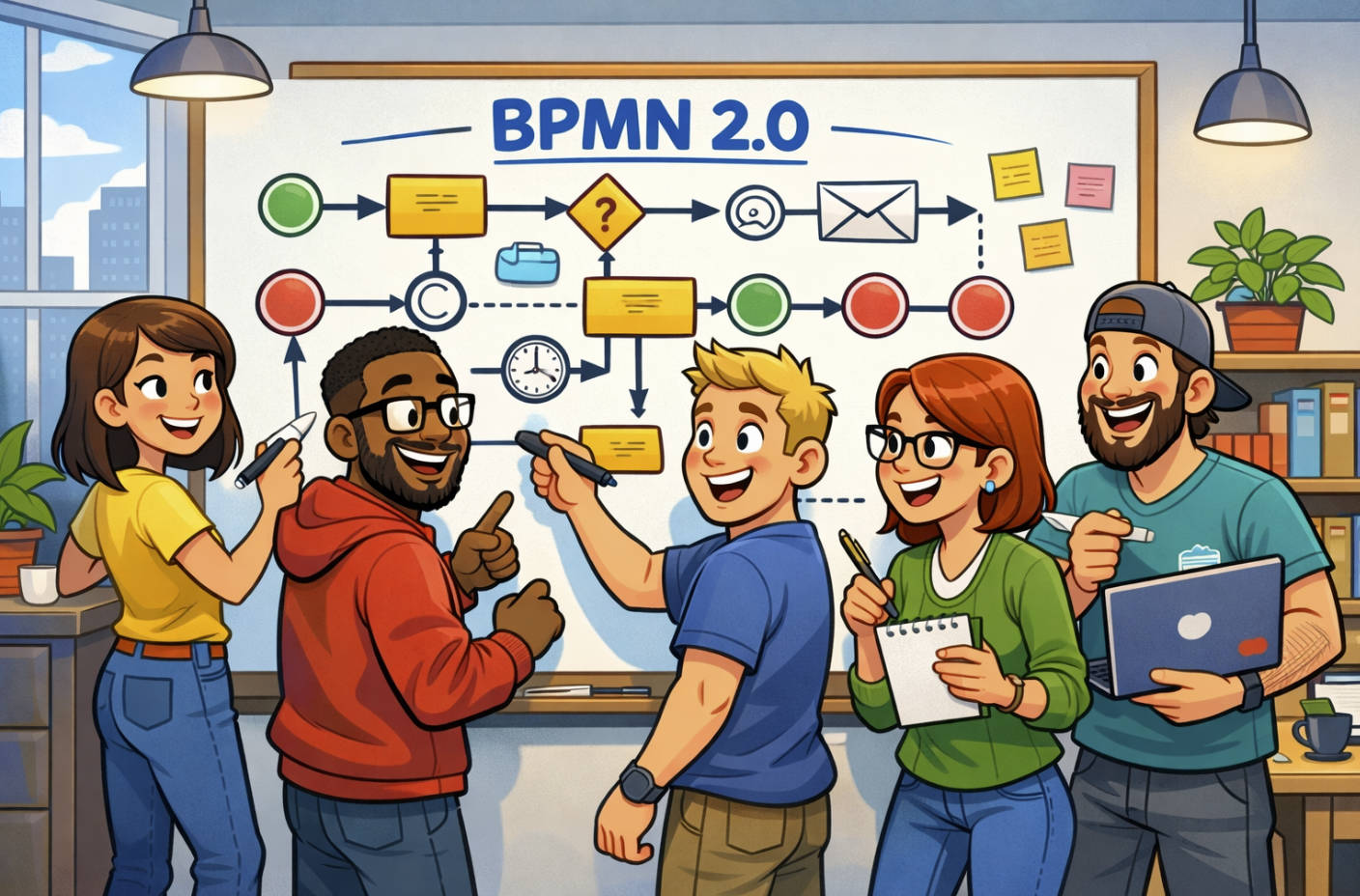
BPMN 2.0 is one of the clearest ways to represent how work actually happens.
It creates a shared language across business and technical teams.
It reduces ambiguity and helps organisations see their processes end to end.
But BPMN 2.0 only works well when the right information is captured.
That information does not live in tools or systems alone.
It lives with stakeholders.
Good BPMN process mapping is less about symbols and more about how you engage people.
Start With the Right Stakeholders in the Room
Before any modelling begins, it is critical to identify who actually does the work.
Job titles alone are not enough.
You need people who understand day to day tasks, exceptions and workarounds.
Include frontline staff, team leads and system owners where possible.
Each group sees the process differently.
BPMN becomes stronger when those perspectives are brought together early.
Leaving voices out usually results in gaps that surface later.
Set Clear Expectations Before Modelling
Stakeholders often arrive at workshops unsure of what BPMN is.
Some assume it is highly technical.
Others think it is documentation for compliance only.
Take time upfront to explain the purpose.
Let them know the goal is to reflect reality, not perfection.
This reduces defensiveness and encourages honesty.
When people understand why the map is being created, they engage more openly.
Use Conversation Before Notation
A common mistake is opening modelling software too early.
When screens take over, people stop talking.
Start with conversation.
Ask stakeholders to walk through the process in their own words.
Listen for handoffs, delays, decision points and frustrations.
Capture notes first.
Only introduce BPMN notation once the flow is understood.
This keeps the model grounded in real behaviour rather than assumptions.
Focus on Decisions and Exceptions
Happy paths are easy to map.
The real value of BPMN sits in decisions and exceptions.
Ask questions like what happens when something goes wrong.
Ask who decides and what information they need.
Ask what causes rework.
These details are often skipped but they shape how the process truly operates.
Strong BPMN maps surface these areas clearly.
Use Simple Language During Workshops
BPMN has formal terms, but workshops should not feel technical.
Use everyday language when facilitating.
Translate stakeholder words into BPMN silently as you model.
When people hear their language reflected back visually, trust increases.
They are more likely to correct errors and add detail.
Clarity matters more than technical purity in early sessions.
Validate Frequently and Visually
Do not wait until the end to validate the model.
Check understanding often.
Pause and ask if the flow reflects reality.
Walk through scenarios together.
This helps stakeholders spot missing steps or incorrect sequencing.
Validation during workshops reduces rework and builds ownership.
Keep the Model Fit for Purpose
Not every BPMN map needs full detail.
Over modelling creates confusion.
Be clear about the level of detail required.
Sometimes a high level view is enough.
Other times detailed task flows are needed.
Good BPMN modelling balances accuracy with usability.
Final Thought
BPMN 2.0 is a strong framework.
But its quality depends on the quality of stakeholder engagement.
Clear facilitation, good listening and thoughtful validation are what make process maps useful.
When stakeholders feel heard, the model improves.
And when the model reflects reality, it becomes a tool people actually use.