

Think back to your last new starter.
They arrived on a Monday.
Someone showed them where the kettle was.
Then they spent the week asking “sorry, how do I do this?”
That’s not a people problem.
It’s a documentation problem.
Most teams run on knowledge that lives in a few heads.
New starters have to extract it one question at a time.
🕳️ What a patchy start costs
New starters who can’t find answers do 3 things.
They interrupt a colleague, guess, or quietly stay stuck.
All 3 cost time.
The colleague loses focus.
The guess becomes a mistake.
The stuck person loses confidence in week 1, which is when it matters most.
🧭 A 30 day roadmap works better than a binder
A 300 page onboarding manual never gets read.
A simple 30 day roadmap does.
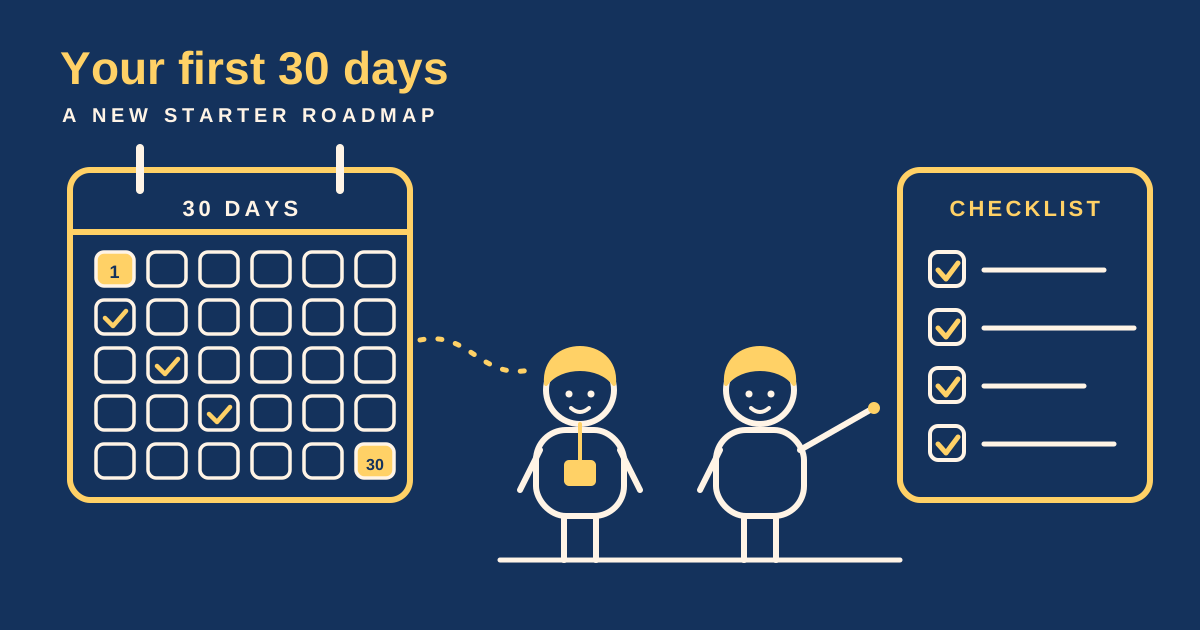
Break it into 4 stages.
- Day 1. Where to find things, who to ask, plus what to do first.
- Week 1. The 5 tasks they’ll do most, with step by step guides.
- Week 2 to 3. How the team’s processes connect, shown as a simple map.
- Day 30. A check in, plus a list of what they’d improve.
Each stage has a clear output.
Nobody is guessing what “settled in” means.
📚 4 documents every new starter needs
1. A day 1 guide. One page. Logins, key contacts, where files live, plus the team’s working hours.
2. A role map. Who does what, by job title. When someone asks “who approves this?”, the answer is written down.
3. Step by step task guides. Short ones, with screenshots. Each covers one task from start to finish.
4. A plain English glossary. Every team has its own shorthand. A list of 20 terms can save hours of confusion.
None of these needs to be long.
They need to be accurate, easy to find, plus owned by someone.
🗺️ Show how the work flows
New starters see tasks in isolation.
They don’t see how one step feeds the next.
A simple process map fixes that.
I use BPMN 2.0, so anyone can read it after a 5 minute explanation.
They see where their work starts, who it goes to, plus where it can get stuck.
🤝 Let new starters help improve it
The best editors are the newest people.
They notice what’s missing because they’ve just hit the gap.
At day 30, ask 3 questions.
What was confusing?
What did you have to ask 3 times?
What would you add?
Update the guides with their answers.
Then the next person gets a better start.
📏 How to tell if it’s working
Keep it simple.
- How long until a new starter completes a task unaided?
- How many questions go to the same 2 colleagues?
- How does the new starter rate their first month, out of 5?
If the numbers move, you’re on the right track.
If not, the guides need work.
🤖 A note on AI
AI can turn interview notes into a first draft quickly.
I use it to speed up documentation by up to 70%.
But someone who knows the work has to check every line, because a wrong step in a guide is worse than no guide.
📞 Want to build one?
If your team onboards people often, a good set of guides pays for itself.
I run short workshops, capture how the work is really done, plus write the guides your new starters need.
Start with a free 30 minute call.
No pitch, no pressure.
Start a project here https://alisodigital.com/start-a-project/
Aiver Ilaya is the founder of Aliso Digital, a Melbourne IT consultancy. Clients call me at the difficult point. The system is coming, nobody agrees on how the work is done today, and go live is close.