

I’ve lost contracts because of an office mandate.
I’ve lost gigs.
I’ve lost interviews.
The pattern is always the same.
The interview goes well.
Then comes “we need you in 2 or 3 days a week”.
I say I can do 1.
That’s the end of it.
It was never about skill.
It was about a rule.
Here’s what that costs employers.
📉 The hiring cost
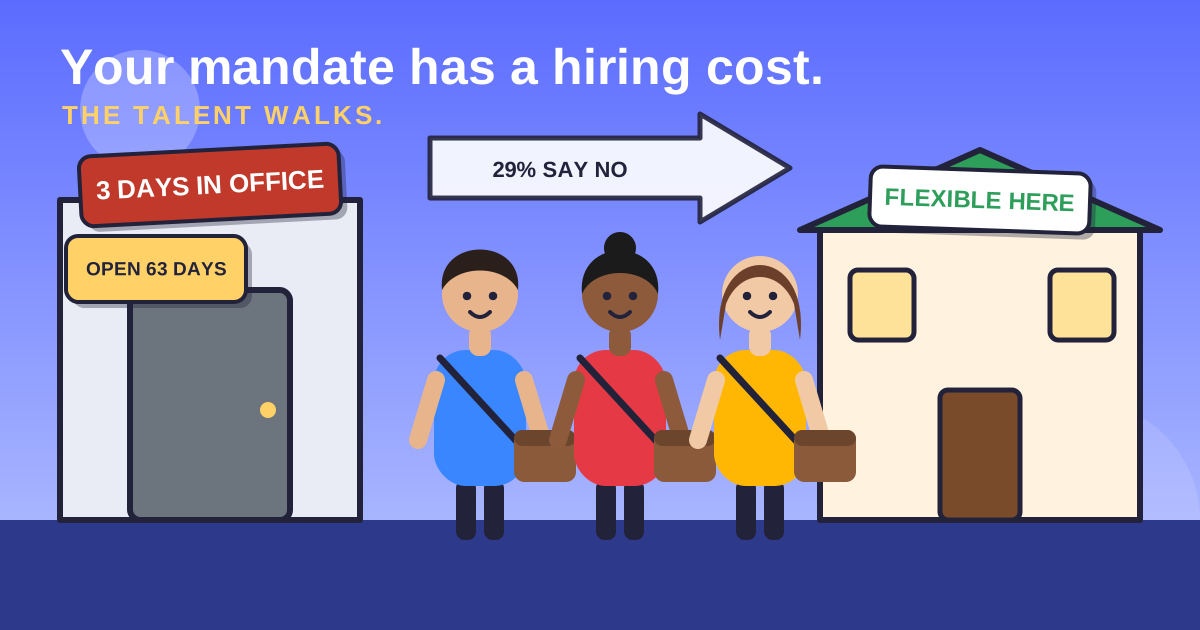
A Robert Half survey of 500 Australian hiring managers found that 29% of job seekers turned down an offer because of an office attendance mandate.
That’s reported by the hirers themselves.
A US study of 54 large tech plus finance firms found abnormal turnover rose 13 to 14% after mandates were announced.
Vacancies took 23% longer to fill, going from 51 days to 63.
Hire rates fell 17%.
Who left first?
Senior managers, high-skilled staff, plus women.
Female turnover rose nearly 3 times as much as male turnover.
Those are US figures from large firms.
Australian evidence is thinner.
But the pattern matches what contractors tell each other.
🧮 Flexibility keeps people
The Trip.com trial is worth repeating.
Moving workers from 5 office days to 3 plus 2 at home cut resignations by 33%.
Productivity and promotion rates didn’t change.
Women, non-managers, plus people with long commutes were the least likely to quit.
That’s a lot of retention for a policy that costs nothing.
🧩 The contractor problem
Here’s where it hurts most.
Contractors come in for a defined project.
They usually do the same work from anywhere.
Ask for 3 office days and your pool shrinks fast.
It becomes people who live close, plus people willing to accept the commute.
The ones who can’t, or won’t, never apply.
You can’t see what you missed.
The best person for the job might have been the one you turned away.
🏛️ It’s a live debate in Victoria
Victoria planned to give eligible workers a legal right to work from home 2 days a week.
On 10 September 2026, the upper house voted 18 to 17 to defer the bill plus refer it to a committee.
The ABC reported it’s unlikely to pass before the November election.
Property Council Victoria welcomed the deferral.
The Business Council of Australia urged the government to drop the proposal.
The Premier called the result “anti-family” plus “anti-worker”.
I’m not here to pick a side in the politics.
I’m saying it shows how divided this is.
⚖️ What the other side says
Employers have every right to set terms.
Some roles need people on site.
Some teams do their best work together, plus some people want the structure.
Most of the big studies come from US firms, so they won’t match every Australian workplace.
I accept that.
But a rule should have a reason.
“Because that’s the policy” isn’t one.
✅ What smart employers can do
- Say why. Link office days to specific outcomes.
- Treat contractors differently. They’re hired for outputs, not attendance.
- Pilot flexible options. Measure delivery, retention, plus hiring time.
- Document the work. Teams that write things down need fewer people in the room.
📞 Need a hand with a rollout?
I work with Melbourne teams on process mapping, documentation, plus go live support.
I’m happy to join key workshops in person, plus do the rest remotely.
Start with a free 30 minute call.
No pitch, no pressure.
Start a project here https://alisodigital.com/start-a-project/
Aiver Ilaya is the founder of Aliso Digital, a Melbourne IT consultancy. Clients call me at the difficult point. The system is coming, nobody agrees on how the work is done today, and go live is close.