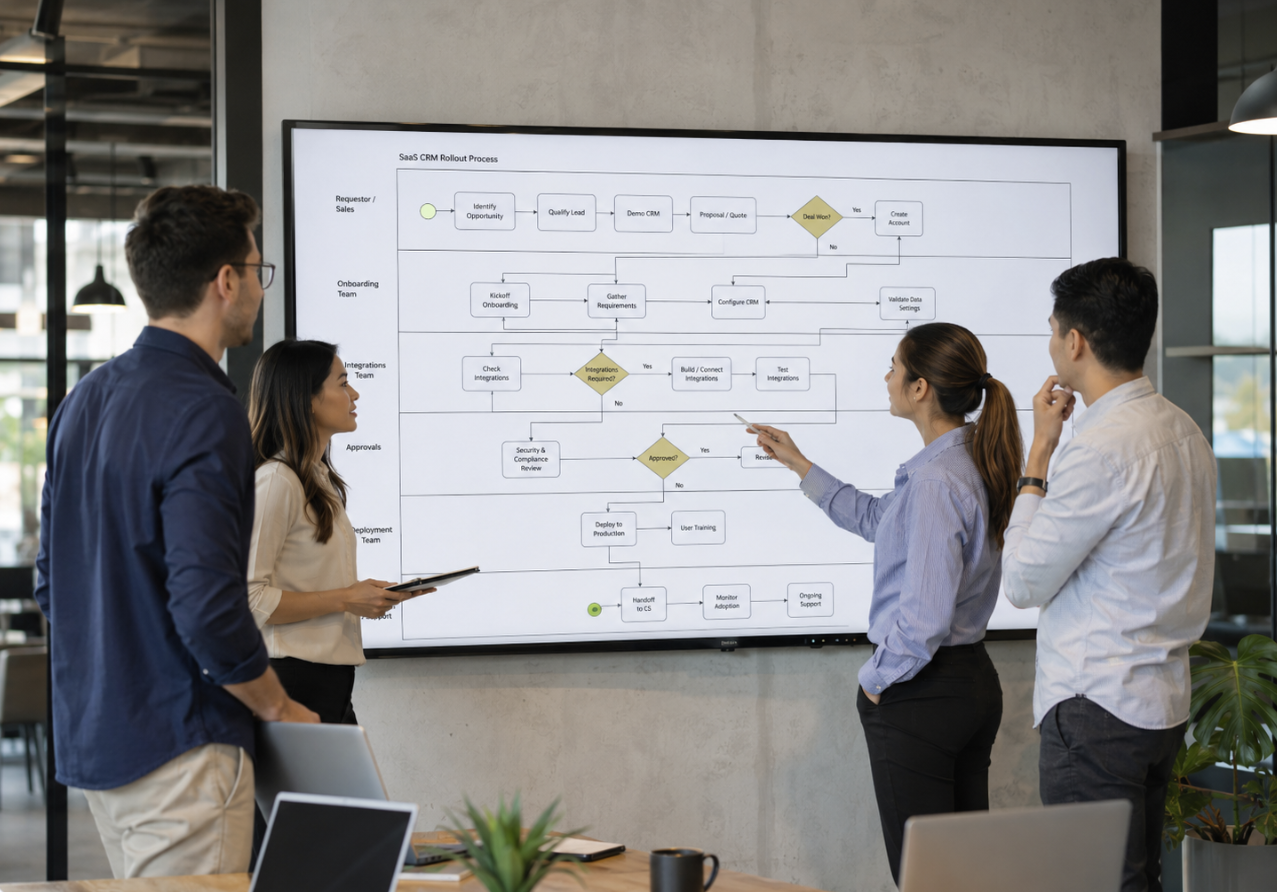
The default way to run a current state session is to get everyone in a room, put a blank wall in front of them, then build the map live.
It’s the accepted approach.
It’s also the reason process mapping workshops have the reputation they do.
Three hours disappear, the loudest person sets the version of events, the quiet person who handles the exceptions says nothing, then you leave with a whiteboard photo plus a headache.
There’s a better sequence, which is to arrive with a consolidated draft already built.
Not a guess.
A version 1 assembled from what everyone told you separately, beforehand.
📝 Ask people to describe their part in plain writing first
Before booking anything, send each stakeholder a short request.
Describe your part of this process in your own words, as if explaining it to a new starter.
No template, no notation, no form.
Just plain prose, a few paragraphs.
Most people can do that in 10 minutes at their desk, which is a far smaller ask than a 90 minute workshop.
Why this works better than it sounds.
- Nobody is performing in front of their manager, so you get the honest version
- Writing forces specificity that conversation lets people skate over
- You capture who said what, which matters when versions conflict
- Introverts contribute properly, sometimes for the first time on a program
- People include the exceptions, because there’s no clock ticking
Give them 3 prompts to answer rather than leaving it open.
What kicks this off for you, what you actually do, then what tends to go wrong.
That’s enough structure to keep responses useful without turning it into homework.
🧩 Aggregate the accounts into a consolidated version 1
Now you’ve got 6 or 8 written accounts describing the same process from different seats.
Your job is turning that into a single BPMN 2.0 draft.
This is where AI genuinely helps, since it’s a summarising and reconciliation task across a lot of text.
Feed in the accounts, then ask direct questions.
- Where do these descriptions agree on the sequence?
- Where do they contradict each other?
- Which steps are mentioned by only 1 person?
- What decision points appear, then what triggers each path?
- Which handoffs are described differently by the sending team versus the receiving team?
Verify everything, obviously.
The output is a starting point rather than an answer.
Then model it properly in BPMN 2.0, using tasks, sequence flows, exclusive gateways, pools, lanes.
Mark every disagreement visibly on the map.
A question mark, a coloured annotation, a note saying two teams describe this differently.
Those marks become your agenda.
🎯 Now the workshop has a job
Walking in with a consolidated V1 changes what the session is for.
You’re no longer asking people to build something from nothing.
You’re asking them to resolve a small number of specific disagreements, which is a much better use of 8 people’s time.
A session structured that way looks like this.
- Ten minutes walking the draft end to end, so everyone sees the whole flow
- The bulk of the time on the marked disagreements only
- A short pass on anything nobody mentioned, in case there’s a gap
- Agreement on what stays unresolved, plus who follows up
Sixty minutes covers that comfortably.
Compare it to 3 hours producing something less accurate.
There’s a second benefit that’s easy to miss.
People see their own contribution reflected in the draft, sometimes attributed.
That does more for engagement than any amount of stakeholder communication planning.
⚔️ Reconciling versions is the actual work
Here’s the part people underestimate.
Everyone’s AS-IS is slightly different, which isn’t a problem with your stakeholders.
It’s the finding.
Operations describes an approval that finance says doesn’t happen.
Two branches run the same process with different thresholds.
The receiving team says work arrives incomplete about a third of the time, which the sending team has never been told.
None of that surfaces if you build the map live, because the group converges on a single version in the room, usually whichever version the most senior person describes.
Building separately then reconciling keeps the differences visible long enough to be useful.
How to handle them without picking a fight.
- Record both versions in the stakeholder’s own words
- Show what each version costs in time, rework, or risk
- Name the difference plainly in the session, without judgement
- Hand the decision to whoever owns the process, rather than deciding yourself
Arbitrating between 2 teams puts you in the middle of something that isn’t yours.
Making the choice visible, evidenced, easy is where the value sits.
🚧 Where this approach struggles
Worth being honest about the limits.
Some people won’t write anything back, no matter how small the ask.
Chase once, then book 15 minutes with them instead, since a short conversation beats a non-response.
Written accounts also skew towards the standard path, because people describe what they usually do.
So the workshop still needs a deliberate pass on exceptions.
Ask what happens when the system’s down, what happens when the usual approver is away, what causes the most complaints.
Finally, don’t let the draft become authoritative in your own head.
A consolidated V1 is a hypothesis, not a finding.
Turn up genuinely willing to be wrong about it.
✅ What changes when you work this way
Shorter workshops.
Better attendance, because a 60 minute ask is easier to say yes to than a 3 hour one.
A more accurate map, because the quiet people contributed properly.
A visible record of who described what, which settles arguments later.
Most importantly, the session becomes about resolving differences rather than assembling a process from scratch.
That’s the shift.
Stop using workshops to gather information.
Use them to reconcile it.
About the author
Aiver is the managing consultant at Aliso Digital, an IT consultancy based in Melbourne.
For 19 years he’s worked on enterprise digital transformation programs.
His experience spans ITSM, HRIS, ERP, CRM, POS, KMS and EDRMS platforms, plus workflow automation.
His work covers business analysis, process optimisation, technical writing, knowledge management and UI / UX design.
He has worked across government, healthcare, science and medical research, finance, education, telecommunications, infrastructure, aviation, construction and property, technology, retail, logistics, pharmacy, insurance and professional services.
He has worked on multi-million dollar programs running years at a time, for national organisations and global firms, reaching millions of end users.
He has run his own consultancy for 12 years and works with a small number of clients at a time.
Available for remote and hybrid contracts.
alisodigital.com