
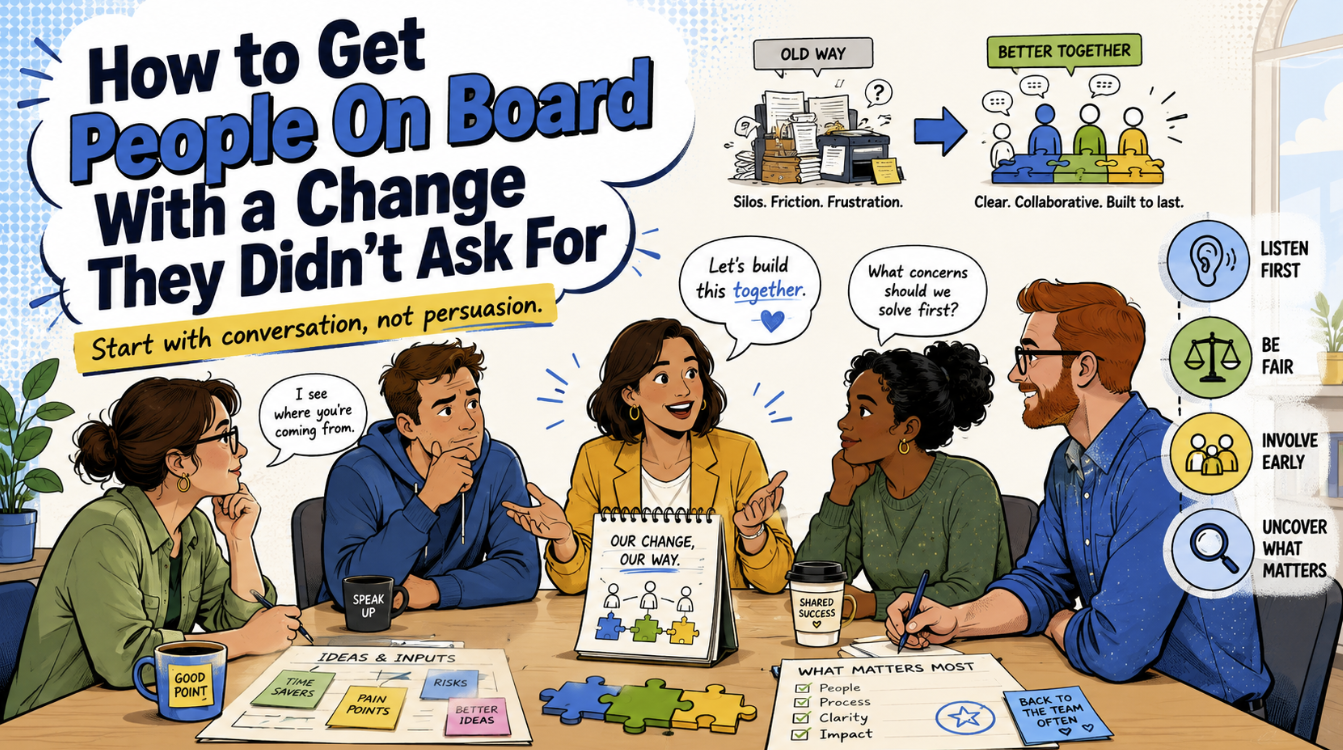
This comes up in almost every process analyst interview.
How do you handle resistance to change.
The honest answer is that most people aren’t resisting change itself.
They’re resisting being changed by someone who hasn’t asked them anything.
There’s a difference, though it takes a while to see it.
Once you do, the job stops being about persuasion, starts being about conversation.
Here’s what’s worked for me across a few large programs.
⚖️ Talk about what they stand to lose, not what they’ll gain
Project communications almost always lead with benefits.
Faster processing, better visibility, fewer manual steps.
It sounds good in a slide deck, though it rarely moves anyone.
People will work much harder to avoid losing something than to gain something of equal value.
So flip the framing.
Instead of describing the upside of the new way, describe the cost of the current one, in their terms.
- The 4 hours a week they spend rekeying data into 2 systems
- The audit finding that keeps coming back every year
- The complaints their team fields because a status isn’t visible
- The new starter who takes 6 months to get up to speed
None of that is invented pressure.
It’s just naming what the current state already costs them, which they usually feel but haven’t said out loud.
A person who recognises the cost of standing still becomes far easier to bring along.
🤝 Use the word “fair”, then mean it
Resistance often isn’t about the process at all.
It’s about the sense that a decision has been made somewhere else, by people who won’t live with it.
Say early on that you want them treated fairly through this.
Then back it up.
- “If any part of this feels unfair to your team, tell me while there’s still time to change it”
- “I don’t want to design something that quietly makes your job harder”
- “What would feel unreasonable to you here?”
That last question is worth asking properly.
Most people have never been asked it during a change program.
When you ask it, then actually adjust something small in response, word travels quickly.
You become the person who listens rather than the person delivering the news.
Fairness is cheap to offer, expensive to fake, so only offer it if you’ll follow through.
🔍 Find the thing nobody’s told you yet
Every stubborn pocket of resistance has a reason underneath it.
Usually it’s a piece of information the project doesn’t have.
A team that seems difficult about a new approval step might be carrying a regulatory obligation nobody mapped.
A supervisor blocking a system change might have been burned by the last rollout, then blamed for it.
A quiet team might be 2 people short, so any extra work is genuinely impossible right now.
Those details rarely arrive in a workshop.
They come out in a 15 minute conversation where you’re not selling anything.
Some questions that surface them.
- “What’s the hardest part of this for your team?”
- “What am I missing about how this really works?”
- “What happened last time something like this came through?”
- “What would need to be true for this to work for you?”
One of those answers will usually explain everything you’ve found confusing.
Resistance that looks irrational from the outside almost always makes sense once you know the missing piece.
Your job is finding it, not arguing with the symptom.
🗣️ Slow the conversation down
When someone pushes back hard, the instinct is to respond quickly with facts.
Facts don’t land while someone feels unheard.
So slow everything down.
Steady pace, shorter sentences, longer pauses.
Repeat back what they’ve said before you reply to it.
Then check you’ve got it right.
“So the concern is that this adds a step for your team, without removing anything at the other end.”
If they say “that’s right”, you’re finally in the same conversation.
If they say “not quite”, you’ve avoided solving the wrong problem.
Either way, you’ve lost 30 seconds, gained a real starting point.
👥 Bring people in before the design is finished
Consultation after a decision is just an announcement with a longer meeting.
People know the difference immediately.
So involve them while things are still genuinely movable.
- Show rough drafts, not polished ones
- Ask them to correct your understanding, rather than approve your solution
- Give them 2 or 3 workable options where you can
- Tell them plainly which parts aren’t negotiable, then why
That last point matters more than people expect.
Being clear about what can’t change builds more trust than pretending everything’s open.
Adults can handle constraints.
What they can’t handle is a fake choice.
🎤 How to answer this in an interview
If you get asked this question, avoid the textbook answer about communication plans.
Tell a story instead.
Name a specific team that pushed back, what you found out when you sat with them, what you changed as a result.
Then say the bit that most candidates miss.
Resistance is information.
A team that argues is a team that’s paying attention.
The ones you should worry about are the quiet ones who nod in the workshop, then keep using the old spreadsheet 6 months later.
Getting people on board isn’t really a communications exercise.
It’s just talking to people properly, early enough for it to matter.